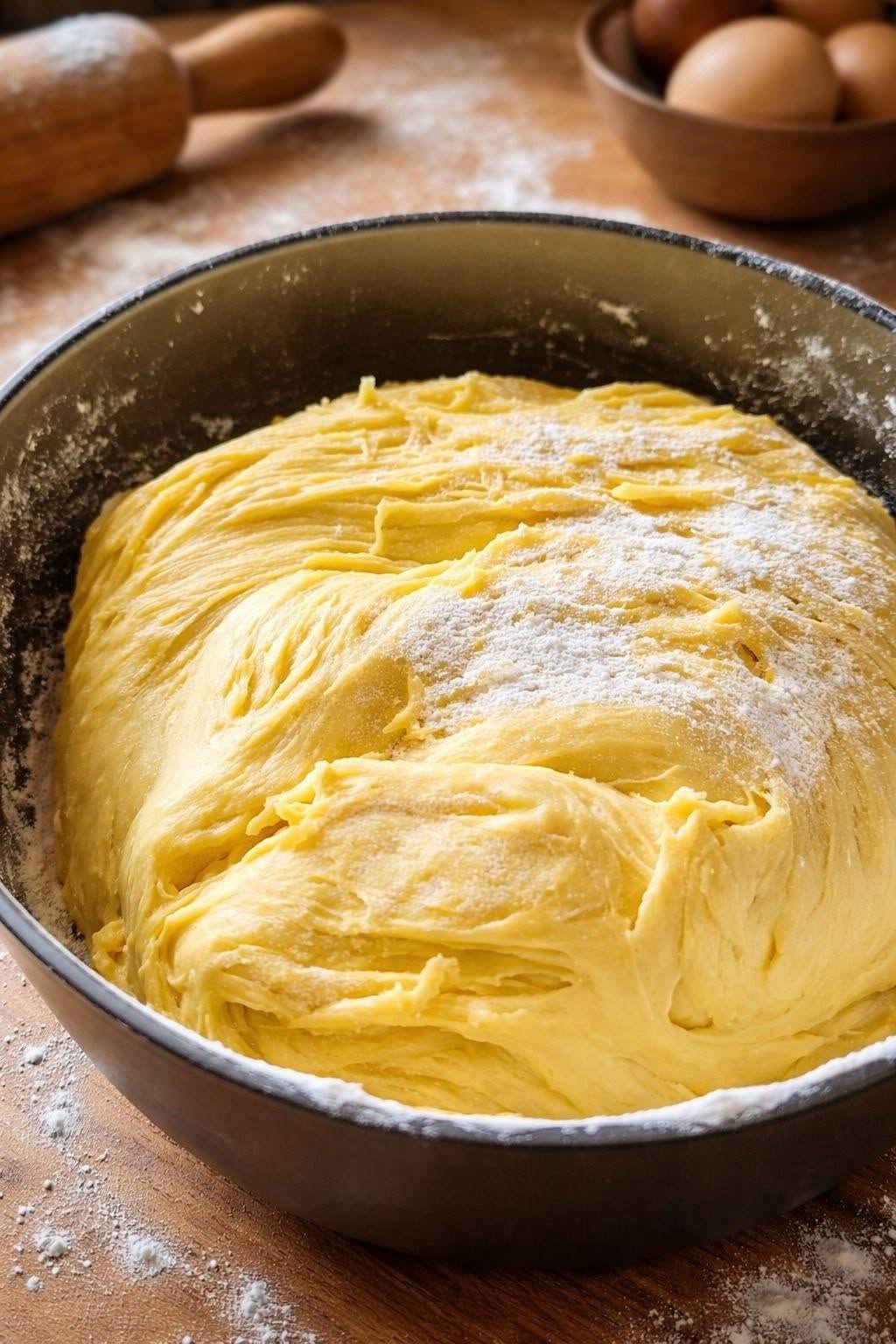
Preparing the brioche dough, step by step
1. Prepare the baker’s yeast
If using fresh yeast, crumble it into a small bowl along with the slightly warmed milk and one teaspoon of the sugar (taken from the total amount called for in the recipe). Stir gently.
Let it rest for a few minutes. You may see some slight activity, though a thick layer of foam does not always form with every type of baker’s yeast.
If using instant dry yeast, check the manufacturer’s instructions; some varieties can be mixed directly into the flour without needing to be rehydrated first.
Be careful not to use milk that is too hot, as excessive heat can damage the yeast.
2. Mix the flour, sugar, and salt
Pour the flour into the bowl of a stand mixer or into a large mixing bowl.
Add the remaining sugar and the salt, then stir to distribute the ingredients evenly.
If using a stand mixer, attach the dough hook. If working by hand, ensure you have a clean work surface and enough space to knead the dough.
3. Incorporate the eggs and yeast
Add the eggs to the flour, then pour in the milk and yeast mixture.
Begin kneading on a low speed until the ingredients come together into a uniform dough.
Continue kneading at a medium speed for about 5 to 7 minutes—adjust the timing based on your specific equipment. The dough should gradually become more elastic and begin to gather around the dough hook.
At this stage, it may still appear slightly sticky; this is normal for a brioche dough enriched with eggs and milk.
4. Gradually incorporate the butter
Cut the softened butter into small pieces. Add them to the dough gradually, waiting until each portion is almost fully incorporated before adding the next.
At first, the dough may appear to fall apart, become greasy, or stick more to the bowl. Keep kneading; it should gradually regain a more uniform texture.
Once all the butter has been incorporated, continue kneading for about 8 to 12 minutes, depending on the power of your stand mixer and the temperature of the dough.
The final dough should be supple, smooth, and elastic, while remaining slightly sticky. Avoid adding too much flour to dry it out, as this could result in a denser brioche.
A good test: if you gently stretch a small piece of dough, it should thin out without tearing immediately. While you don’t need to achieve a perfectly transparent membrane, this check provides a good indication of gluten development.
5. First rise
Gather the dough into a ball and place it in a lightly greased bowl.
Cover with a lid, suitable plastic wrap, or a clean kitchen towel to prevent the surface from drying out.
Let it rise at room temperature for about 1 to 1½ hours, or until the dough has visibly increased in volume—it may grow to nearly double its original size, depending on the conditions.
Do not rely solely on the clock: a cool room will slow down fermentation, while a warmer room will speed it up.
6. Gently deflate the dough
Once the dough has risen sufficiently, turn it out onto a lightly floured work surface.
Press down gently with the palm of your hand to release some of the gas that accumulated during fermentation. The goal is not to knead the dough intensely again, but rather to make it easier to handle and chill.
7. Place the dough in the refrigerator
Form the dough into a ball, return it to a container, and cover it tightly.
Place it in the refrigerator for 4 to 12 hours.
This cold rest slows down fermentation, allows flavors to develop, and—thanks to the butter—generally makes the dough easier to roll out or braid.
The dough may continue to rise slightly while in the refrigerator; this is normal. Just be sure to use a container that is large enough.
8. Shape the brioche as desired
Remove the dough from the refrigerator and place it on a lightly floured work surface.
Divide it according to the shape you want:
Braided brioche: Divide the dough into three or four pieces, roll them into even ropes, and braid them without pulling too tightly.
Individual brioches: Divide the dough into equal-sized portions and shape them into balls.
Loaf-pan brioche: Form several balls and place them side by side in a buttered pan.
Cinnamon rolls: Roll out the dough, spread it with butter and cinnamon sugar, roll it up, and slice it into individual portions.
Brioche wreath: Form several ropes and either braid them or join them together in a circle.
Handle the dough gently to preserve its structure. If it becomes too soft or sticky while you are shaping it, return it to the refrigerator for a few minutes.
9. Perform the second rise
Place the shaped dough pieces onto a baking tray lined with parchment paper, or into a suitable mold.
Cover loosely and allow to rise in a warm, draft-free spot.
Generally, this takes 1 to 2 hours—sometimes longer if the dough is still cold. The brioches should become visibly more puffed up and light.
Avoid using excessive heat to speed up the rising process; the butter could melt, causing the dough to lose some of its structure.
10. Apply an egg wash to the brioche dough
Preheat your oven to 180°C (356°F)—ideally using a conventional (static) heat setting to start—or adjust the temperature according to your specific oven.
Whisk together the egg intended for the glaze with a tablespoon of milk, if desired.
Using a pastry brush, apply a thin layer over the surface of the brioches, being careful not to press down too hard, which could cause them to deflate.
For an extra-glossy finish, you can apply the glaze in two very thin coats, allowing the first to dry slightly before applying the second.
11. Bake until golden brown
Bake smaller brioches for about 15 to 20 minutes, and larger ones for about 25 to 35 minutes. These times will vary depending on the size, the mold used, and your oven.
Keep an eye on the color during the final minutes. If the surface browns too quickly, cover it loosely with a sheet of aluminum foil—ensuring it does not come into contact with the oven’s heating elements.
The brioche should be golden brown and baked through to the center. If you have a kitchen thermometer, you can check the temperature at the center of the largest piece; a temperature of approximately 88–93°C (190–199°F) is a good benchmark for many types of brioche. Let rest for a few minutes in the mold, then carefully unmold and leave to cool on a wire rack.
Read more on the next page >>
