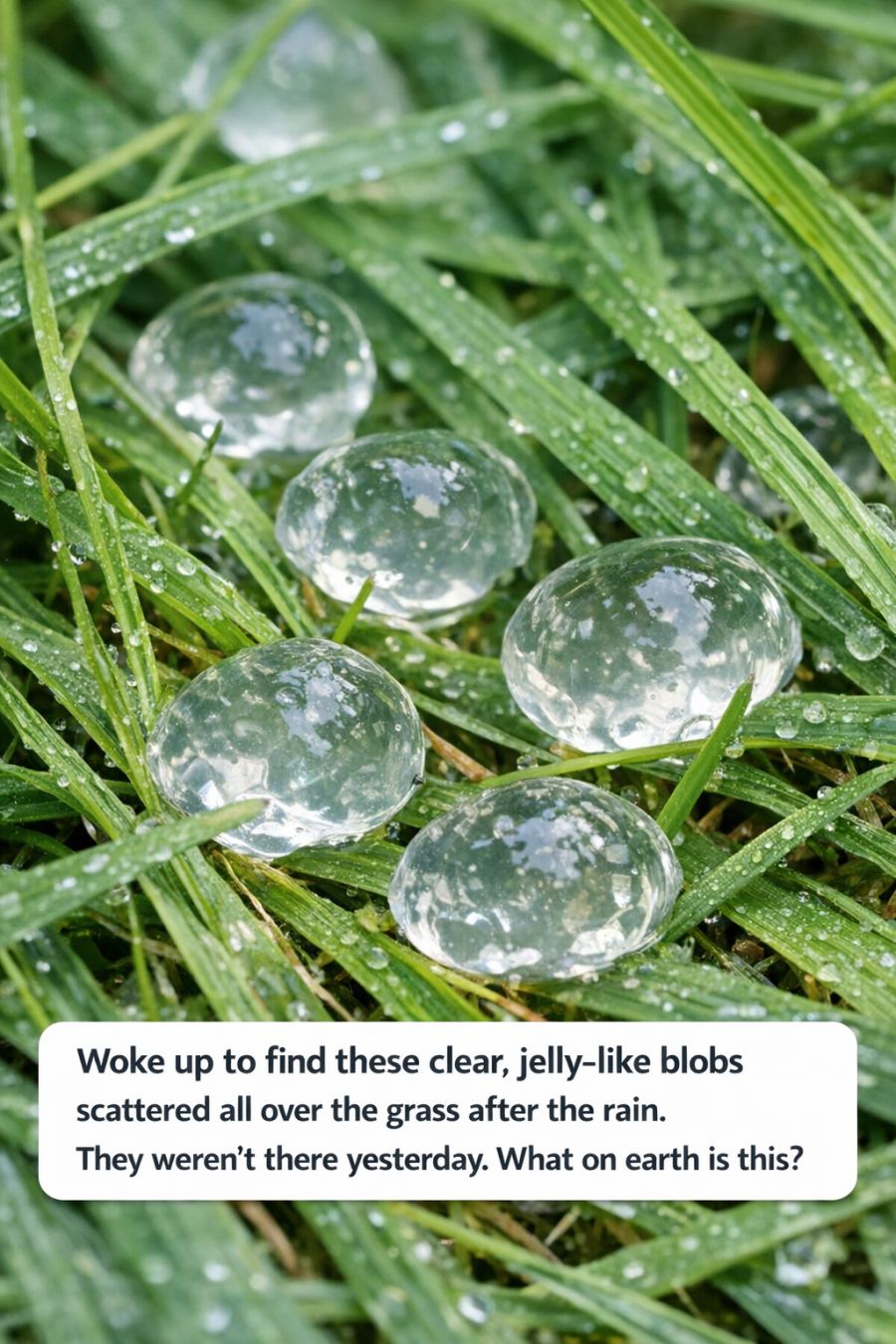
Imagine stepping out into your yard, breathing in the fresh scent of rain-soaked earth, only to be greeted by a peculiar sight: clear, jelly-like blobs scattered across the grass. These strange, amorphous masses weren’t there the day before, leaving you puzzled and wondering what they could be.
Such occurrences after a heavy rainfall are not uncommon, and they have intrigued and baffled people for centuries. This phenomenon has given rise to numerous myths, scientific inquiries, and even some panic. But what exactly are these mysterious blobs, and should we be concerned about their presence?
1. The Morning Mystery: Why Jelly Blobs Appear After Rain
The appearance of these jelly blobs, often after a night of heavy rain, is a perplexing mystery for many. These gelatinous clusters may vary in size, ranging from small pea-sized droplets to larger clumps several inches across. They are typically clear or slightly translucent, and their sudden appearance can seem almost magical.
Rain acts as a triggering mechanism for the transformation of certain organisms in the environment. The moisture provided by rain can activate dormant life forms, causing them to expand and become visible. This transformation is particularly common in areas with abundant organic material and moisture-retentive soils.
2. Star Jelly, Slime Mold, Or Something Else Entirely?
The phenomenon of finding jelly-like substances on the ground has been historically attributed to several possibilities. One popular belief is ‘star jelly,’ a substance thought to fall from the sky during meteor showers. However, scientific explanations often point towards terrestrial sources.
Slime molds, which can appear as jelly-like masses, are another possibility. These organisms are fascinating, as they can exist as single-celled amoebae and aggregate to form larger structures. However, not all jelly blobs are slime molds; some are distinct entities like cyanobacteria.
3. Meet Nostoc: The Cyanobacteria That Masquerades As Alien Goo
Nostoc is a genus of cyanobacteria that is often responsible for these jelly blobs. When dry, Nostoc appears as a crusty, inconspicuous layer on soil or surfaces. However, after a rain, it absorbs water and swells into a jelly-like mass.
Nostoc colonies can be spread over several square centimeters to larger patches, and they thrive in moist, nutrient-rich environments. They are photosynthetic organisms, meaning they can convert sunlight into energy, and they have been part of Earth’s ecosystems for millions of years.
4. How Rainfall Magically Transforms Dry Crusts Into Jelly Masses
The transformation of Nostoc from a dry, crusty form to a jelly-like substance is due to its remarkable ability to absorb water. When it rains, the dormant cells of Nostoc rapidly take up water, expanding to several times their dry size.
This process not only makes the Nostoc more visible but also reactivates its metabolic processes. The rain provides the necessary moisture for the cyanobacteria to resume photosynthesis and growth, contributing to its persistence in various environments.
5. Where These Clear Blobs Usually Show Up—And Why Your Lawn Is a Target
Nostoc and similar jelly-like organisms commonly appear in areas where soil conditions are suitable for their growth. Lawns, especially those with poor drainage or rich in organic material, can provide an ideal habitat.
These blobs are often found in gardens, lawns, and even agricultural fields. They prefer moist, shady areas where water tends to accumulate. The presence of decaying organic matter provides additional nutrients, facilitating their growth and making lawns a frequent target.
6. How To Tell Harmless Nostoc From Potentially Harmful Lookalikes
While Nostoc is generally harmless, other substances that may resemble it can pose risks. For instance, some jelly fungi can appear similar but may not be safe to handle or ingest.
